Thundereggs and Oregon Rockhounding
Updated 2026-11-04 · 1011 words
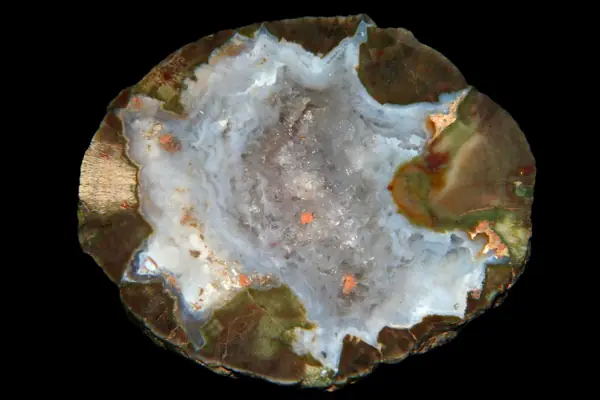
Photo: Lech Darski, CC BY-SA 3.0 (credits). Illustrative.
Oregon is one of the best rockhounding states in the country. The thunderegg, a rough, round nodule with an agate or jasper center, has been Oregon's official state rock since 1965, and the Oregon Department of Geology and Mineral Industries (DOGAMI) says thundereggs are found chiefly in Crook, Jefferson, Malheur, Wasco and Wheeler counties, at both fee and free sites. Oregon also has a free BLM collection area for Oregon sunstone, a gem feldspar, plus fossil sites and agate beaches. This guide covers where to go, what you can collect, and the rules.
Thundereggs: Oregon's state rock
DOGAMI's Oregon Ore Bin reports that the thunderegg was designated the state rock by the 1965 Legislature, with the resolution passed on March 29, 1965. A thunderegg looks like an ordinary knobby rock on the outside, often brown or gray and about the size of a baseball, but when cut and polished it shows a star-shaped or round core of agate, chalcedony, opal or jasper.
Thundereggs are related to geodes. The difference is that a geode is usually hollow with crystals, while a thunderegg is usually filled solid. See our geode hunting guide.
Where to find thundereggs
DOGAMI says thundereggs are found chiefly in Crook, Jefferson, Malheur, Wasco and Wheeler counties in central and eastern Oregon, and that there are both fee sites (private land) and free sites (public land). Check DOGAMI's page and the managing agency before you go, since access and claim status change.
On public land, BLM allows collecting reasonable amounts of rocks and minerals for personal, noncommercial use in most areas. Mining claims are off-limits without permission. See the rockhounding laws guide.
The Oregon Sunstone Public Collection Area (BLM)
The Sunstone Collection Area in Rabbit Basin in south-central Oregon is managed by BLM's Lakeview District. BLM's page says:
- Sunstones are feldspar crystals that formed in lava. About 13 to 14 million years ago, a volcano in the Steens Mountain area erupted massive amounts of lava, which was later covered by a lake. As the lake dried, weathering decomposed the lava and released loose sunstones.
- Boundaries are marked by orange plastic posts and large BLM triangles on wooden posts at the corners.
- There are many private mining claims around the public area and several within it. Collecting from a private claim without permission is not allowed and may result in legal penalties.
- The site is isolated. The only facilities are a pit toilet, picnic tables and a shade structure, and you may camp anywhere within the collection area.
BLM's page gives directions from Plush via the Hogback Road and BLM roads. Come prepared with water, fuel, a spare tire and sun protection.
How to find sunstones
Sunstones lie loose on the surface and in the soft soil. Walk slowly with the sun behind you and look for glints of glassy, transparent crystal, often pale yellow, though some show other colors. Screening the top few inches of soil can help. Bring a loupe, a small trowel and a screen.
Fossils in Oregon
Oregon is also known for fossils:
- Fossil digging site, Fossil, Oregon, in Wheeler County.
- John Day Fossil Beds National Monument is managed by NPS, where collecting is prohibited under 36 CFR 2.1; visit to look and learn.
See our fossil hunting guide for the federal rules.
Gold in Oregon
Our directory also lists BLM recreation sites in Oregon with panning potential, such as Sharps Creek Recreation Site and Yellowbottom Recreation Site. Check claim status and the managing office's rules before panning. See how to pan for gold.
Agates and other Oregon finds
Thundereggs and sunstones are only part of Oregon's rockhounding. DOGAMI's fossils, minerals and gems page also covers agate, jasper and other collectible materials found across the state. Agate and jasper turn up on gravel bars and some beaches, and they make excellent tumbling material. Petrified wood on BLM land is subject to federal limits: 25 pounds plus one piece per day, up to 250 pounds per year, under 43 CFR 3622.4. Before collecting on a beach, check the rules of the agency that manages it, since state parks and other public beaches may restrict collecting.
Planning a central Oregon trip
Most thunderegg country is a long drive from Portland or Bend, and many sites are on gravel roads. Plan a loop that combines a fee site, where you can dig with confidence, with a free public site, and leave time for a rock shop that can cut your eggs. Fee sites are on private land, so their hours and prices are set by the owners; check their websites or call before you go. On public land, confirm the land manager, look for claim markers and carry a map that shows land status.
Cutting thundereggs
Thundereggs show their beauty only when cut. A lapidary saw cuts them in half, and the faces can be polished. Many rock shops and clubs in Oregon offer cutting services. See getting finds cut or faceted and our rock tumbling guide for smaller agate pieces.
What to bring
- A rock hammer and a small pick (hammers)
- Gloves and safety glasses (safety gear)
- Buckets and a backpack
- Plenty of water, food and fuel; Oregon's high desert is remote
- A map showing land status
See our trip checklist.
Oregon rockhounding etiquette
- Stay within marked public areas and respect claim markers.
- Take reasonable amounts for personal use only.
- Fill your holes and pack out trash.
- Leave artifacts and vertebrate fossils in place.
Keep a record
Note the location and date for each specimen you collect. Thundereggs from different beds have distinctive patterns and colors, and collectors value knowing where an egg came from.
When to go
Central and eastern Oregon's high desert is hot in summer and can be snowy in winter. Late spring and early fall are often the most comfortable times. Check road conditions and fire restrictions before travel.
Browse all Oregon listings and the rockhounding list.
FAQ
What is Oregon's state rock?
The thunderegg. DOGAMI's Ore Bin reports it was designated by the 1965 Legislature, with the resolution passed on March 29, 1965.
Where can I find thundereggs in Oregon?
DOGAMI says chiefly in Crook, Jefferson, Malheur, Wasco and Wheeler counties, at both fee and free sites.
Is the Oregon Sunstone Public Collection Area free?
BLM describes it as a public collection area open to visitors, with mining claims around and within it that are off-limits without permission. Check BLM's page for current details.
What is an Oregon sunstone?
A feldspar crystal that formed in lava. BLM says the sunstones in Rabbit Basin came from lava erupted about 13 to 14 million years ago.
Sources
- Fossils, Minerals and Gems – Oregon DOGAMI
- The Ore Bin, vol. 27 no. 10 (PDF) – Oregon DOGAMI
- Sunstone Collection Area – Bureau of Land Management
- Rockhounding on Public Lands – Bureau of Land Management
- 36 CFR 2.1 – Cornell LII
- 43 CFR 3622.4 – Cornell LII
Sources checked 2026-11-04. Rules, hours and fees change; confirm with the operator or land manager before you go.