How to Pan for Gold, Step by Step
Updated 2026-11-04 · 1041 words
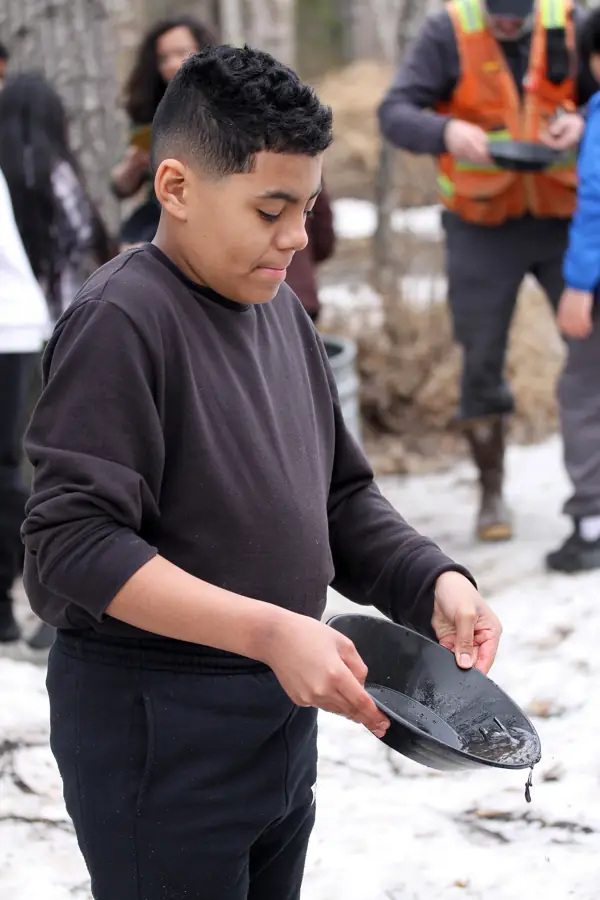
Photo: BLM Alaska, Public domain (credits). Illustrative.
To pan for gold, fill a pan with gravel from a spot where heavy material settles, submerge it, shake it hard to let gold sink, then tilt and swirl to wash the lighter material off the edge until only black sand and any gold are left. It works because gold is extremely dense: the U.S. Geological Survey gives pure gold a specific gravity of 19.3, while ordinary waste rock is about 2.5. This guide covers where to pan, how to do it, and the rules on public land.
Why panning works
Gold in streams comes from placer deposits. The USGS explains that placers form when gold is freed from its original (lode) rock by erosion and weathering, then concentrated by gravity. Because gold resists weathering and is so heavy, it moves less than other material and collects where the current slows. The same density difference that concentrates gold in nature is what makes a gold pan work.
Where to pan in a stream
The USGS notes that gold collects in depressions and in pockets in sand and gravel bars where the stream current slackens, and that prospectors look where coarse sand and gravel have accumulated and where "black sands" have settled with the gold. In practice, look for:
- The inside bends of a stream, where water slows
- The downstream side of large boulders
- Cracks and crevices in bedrock on the stream bed
- Gravel bars, especially near the bottom of the gravel
- Places where heavy black sand shows at the surface
Black sand is a useful sign. The USGS says magnetite is the most common mineral in black sands, along with other heavy minerals. Black sand is not gold, but it travels and settles with gold.
What you need
- A gold pan, typically 10 to 14 inches, ideally with riffles on one side
- A classifier (screen) that fits over a bucket to remove larger rocks
- A small shovel or trowel, where digging is allowed
- A snuffer bottle or tweezers and a small vial for gold
- Rubber boots or waders and gloves for cold water
See the gold pan and classifier section of our gear page for more.
Step-by-step panning
- Classify. Screen your gravel through a classifier into the pan so you are working only finer material. This makes panning faster.
- Fill the pan about two-thirds to three-quarters full.
- Submerge and soak. Put the pan under water in slow-moving water deep enough to cover it. Knead the material with your hands to break up clay and clumps.
- Shake hard. Hold the pan level under water and shake it side to side vigorously. This lets heavy material, including gold, sink to the bottom.
- Remove large stones. Pick out and inspect the larger rocks on top, then toss them.
- Tilt and wash. Tilt the pan slightly away from you, with the riffles on the low side. Dip and swirl so water carries the top layer of light material over the edge. Shake again every few passes to keep gold settling.
- Repeat until you are down to a small amount of heavy black sand.
- Look for color. With a little water in the pan, swirl gently to spread the black sand. Gold looks bright and buttery yellow and stays yellow in shade; fool's gold (pyrite) and mica glitter and change in the light.
- Collect. Pick out gold with tweezers or a snuffer bottle and put it in a vial of water.
Go slowly at first. Most beginners lose gold by tilting too far or washing too fast at the end.
Practice before you go
Many attractions sell bags of "paydirt" or let you pan troughs of prepared gravel. At Reed Gold Mine in North Carolina, the site of the first documented gold find in the United States, the state historic site offers gold panning, and Marshall Gold Discovery State Historic Park in Coloma, California, offers short panning lessons in troughs. Practicing on known gold teaches you what it looks like in a pan. Our directory lists other gold panning spots, including the Crisson Gold Mine in Dahlonega, Georgia.
Rules for panning on public land
Rules depend on who manages the land. Always check the local office.
National forests. The Black Hills National Forest explains that most national forests in western states allow gold panning and sluicing, that hand tools and non-motorized panning are usually allowed without a permit or bond, and that motorized equipment or suction dredges require a Notice of Intent. Some areas are closed, including wilderness areas and mineral withdrawal areas. Rules can be stricter elsewhere: the National Forests in North Carolina allow panning only in the stream bed with a standard gold pan, require holes to be backfilled, and prohibit shovels, picks, sluice boxes and suction dredges.
BLM land. The Bureau of Land Management says rockhounds may collect reasonable amounts of rocks and mineral specimens, including gold, and may prospect with hand tools such as pans, shovels and metal detectors if it causes no more than minor surface disturbance. Collecting on an existing mining claim is prohibited without the claimholder's permission.
National parks. Federal regulations prohibit disturbing or removing mineral resources in park areas, so do not pan in national parks unless a park specifically authorizes it.
Mining claims. Much of the gold-bearing ground in the West is covered by mining claims. Panning on someone's claim without permission is trespass. Recreational areas that are closed to new claims, like Alaska's state recreational mining areas, are a good way to avoid this problem.
Water safety
Streams in gold country can be cold and fast, especially during snowmelt. California State Parks has warned that high, cold, fast rivers make activity at the water's edge, including gold panning, potentially hazardous. Pan in slow water, avoid wading in swift current, and supervise children closely.
How much gold will you find?
Most recreational panners find small flakes, sometimes called "color." Finding nuggets is uncommon. Treat panning as a hobby and a way to learn about geology rather than a way to make money. If you want to process more gravel, read our comparison of a sluice box vs. a gold pan.
FAQ
How do you know if it's gold in your pan?
Gold is very heavy and stays at the bottom of the pan, and it keeps a soft yellow color in shade. Pyrite and mica glitter, change in the light and wash out more easily.
Can you pan for gold anywhere?
No. National parks prohibit removing minerals, mining claims are off-limits without permission, and some national forests have extra limits. BLM and many national forest lands allow hand panning; check the local office first.
Do I need a permit to pan for gold in a national forest?
Usually not for hand panning with non-motorized tools, according to the Forest Service. Motorized equipment and suction dredges require a Notice of Intent, and some forests restrict panning further.
What is black sand?
Heavy minerals that settle with gold. The USGS says magnetite is the most common mineral in black sand.
Sources
- Prospecting for Gold in the United States – USGS
- Gold Panning, Rockhounding & Metal Detecting – Black Hills National Forest, USFS
- Recreational Mineral Collection – National Forests in North Carolina, USFS
- Can I Keep This? – Bureau of Land Management
- 36 CFR 2.1 – Preservation of natural resources (NPS)
- Reed Gold Mine – NC Historic Sites
- Marshall Gold Discovery SHP – California State Parks
Sources checked 2026-11-04. Rules, hours and fees change; confirm with the operator or land manager before you go.