How to Identify Common Gem Mine and Rockhounding Finds
Updated 2026-11-04 · 1013 words
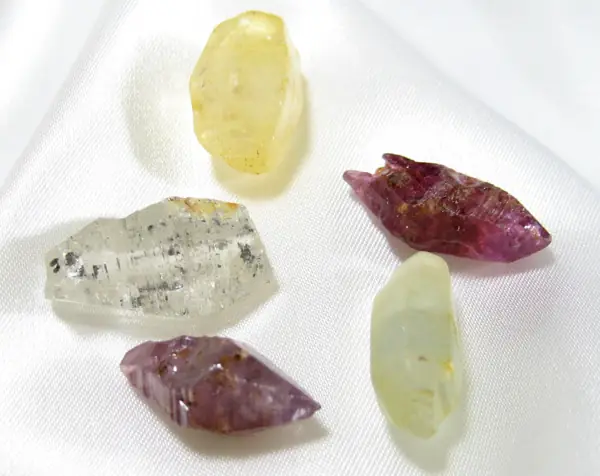
Photo: Ra'ike (see also Ra'ike on de.wikipedia, CC BY-SA 3.0 (credits). Illustrative.
Most finds at US gem mines and rockhounding sites are quartz (clear, white, purple or smoky crystals), garnet (dark red to brown, often round crystals), agate and jasper (waxy, banded or opaque silica), corundum (ruby and sapphire, heavy and often dull outside) and, in a few places, beryl, including emerald. You can narrow down most finds with four simple observations: crystal shape, luster, weight for its size, and hardness. This guide covers the common ones and how to tell them apart, with notes from state geological surveys and the USGS.
Four simple tests
- Crystal shape. Many minerals grow in characteristic shapes. Quartz forms six-sided prisms with pointed ends; garnet forms roughly ball-shaped crystals with many faces; corundum often forms six-sided barrels or flat hexagonal plates.
- Luster. How the surface reflects light: glassy (quartz, garnet), waxy (agate, chalcedony), metallic (pyrite, gold) or dull.
- Weight for size. Gems such as corundum and garnet feel noticeably heavy compared with ordinary rock of the same size. Gold is far heavier still.
- Hardness. On the Mohs scale, quartz is 7 and will scratch glass; corundum is 9 and will scratch quartz. Only test on a hidden spot, and never test a stone you might cut.
A 10x loupe helps you see crystal faces, inclusions and luster. See loupes on our gear page.
Quartz
Quartz is the most common find. The Arkansas Geological Survey describes it as silica (SiO2), hard, brittle and resistant to weathering, and usually colorless or white. Look for six-sided crystals with pointed terminations and a glassy luster. Varieties include:
- Rock crystal: clear quartz, as at the Arkansas mines like Wegner Quartz Crystal Mines and Ron Coleman Mining.
- Herkimer diamonds: clear, double-pointed quartz crystals from New York. See our Herkimer diamond guide.
- Amethyst: purple quartz. Crater of Diamonds State Park lists amethyst among the minerals found there.
- Smoky quartz and citrine: brown to gray, and yellow to orange.
Agate, jasper and chalcedony
These are also silica, but made of microscopic crystals. Agate is translucent and often banded; jasper is opaque and often red, yellow or brown; chalcedony is the general name for the waxy, translucent material. They feel smooth and waxy rather than glassy, and they take a great polish in a rock tumbler. Oregon's state rock, the thunderegg, is a nodule typically filled with agate; see our thundereggs guide.
Garnet
Garnet is a family of minerals. The USGS notes the name comes from the Latin granatus, "like a grain," because crystals often resemble seeds embedded in rock. Common garnets are dark red to reddish brown; some are orange, green or nearly black. Look for roughly spherical crystals with many flat faces (often 12 or 24 faces), a glassy luster and a heavy feel. Garnets are common at North Carolina mines such as Cherokee Ruby & Sapphire, at Garnet Hill in Nevada, and in the volcanic crater at Crater of Diamonds.
Corundum: ruby and sapphire
Red corundum is ruby; every other color is sapphire. Rough corundum often does not look like a gem: it may be dull, opaque, and pink, gray, blue or brownish. Clues are its weight, a six-sided barrel or flat hexagonal plate shape, and a slightly greasy or silky surface. The North Carolina Geological Survey notes rubies and sapphires in Macon County, around Franklin. Montana is famous for sapphires; see our Montana sapphire guide.
Beryl: emerald and aquamarine
Beryl forms six-sided prisms with flat ends (not pointed like quartz). The North Carolina Geological Survey describes emerald as a variety of beryl with a hardness of 7.5 to 8, colored by trace chromium or vanadium. Pale blue to blue-green beryl is aquamarine. North Carolina's significant emerald deposits are in Alexander and Mitchell counties, according to the survey; Emerald Hollow Mine in Hiddenite lets the public prospect.
Tourmaline
Tourmaline forms long prisms with lengthwise grooves (striations) and a rounded-triangle cross-section. Colors range from black (very common) to pink, green and multicolored. Southern California's pegmatite mines, including the Oceanview Mine in Pala, list tourmaline among their finds.
Pyrite vs. gold
Pyrite ("fool's gold") is brassy, often forms cubes, and is brittle: it crumbles if you press it with a knife point. Gold is soft and bends or dents instead. The USGS gives pure gold a specific gravity of 19.3, so it sinks to the bottom of a pan and stays put, while pyrite and flaky mica wash out more easily. See how to pan for gold.
Diamonds
Rough diamonds at Crater of Diamonds look like small, rounded, oily-looking pebbles; the park says the three colors found there are white, brown and yellow. The park's staff provide free identification of rocks and minerals found at the park.
Fossils
Fossils are not minerals, but rockhounds find them often. Common ones include brachiopods, crinoid stems and trilobites. See our fossil hunting guide for where collecting is allowed.
Get a second opinion
Staff at most pay-to-dig mines identify finds, and many state geological surveys answer questions from the public. The North Carolina Geological Survey's FAQ addresses whether it can identify rocks and minerals. For valuable-looking stones, have them identified before cutting.
Feldspar, mica and other common minerals
Not everything in a bucket or on a hillside is a gem. Feldspar is extremely common: it is usually white, pink or cream, blocky, and breaks along flat, shiny surfaces. Mica peels into thin, flexible, shiny sheets and glitters in sunlight, which is why it is often mistaken for gold in a pan. Black, glassy, striated prisms are usually black tourmaline (schorl). Learning to recognize these common minerals quickly saves time, because it lets you focus on the less common stones that are worth a closer look.
Keep notes on your finds
Write down where and when you found each stone, and keep the label with the specimen. Location information is what makes a specimen meaningful to other collectors, to mine staff helping you identify it, and to you years later. A small notebook, zip-top bags and a permanent marker are enough.
FAQ
How do I tell quartz from a diamond?
Quartz usually forms six-sided crystals with pointed ends and a glassy luster. Rough diamonds from Crater of Diamonds look like small rounded, oily-looking pebbles. Ask park staff, who provide free identification.
How do I tell gold from pyrite?
Gold is soft, bends instead of crumbling, keeps its color in shade and is far heavier. Pyrite is brittle, brassy and often forms cubes.
What does a rough ruby or sapphire look like?
Often dull and opaque, in a six-sided barrel or flat hexagonal shape, and heavy for its size. Red is ruby; other colors are sapphire.
Is my red stone a garnet or a ruby?
Garnets are usually rounded crystals with many faces; corundum forms six-sided barrels or plates and is harder. Have it checked by mine staff.
Sources
- Quartz (Industrial) – Arkansas Geological Survey
- Gemstones: Garnet – USGS
- Gemstones: Quartz – USGS
- Emeralds – North Carolina Geological Survey
- NC Geology FAQ – North Carolina Geological Survey
- Prospecting for Gold in the United States – USGS
- Crater of Diamonds State Park – Arkansas State Parks
- Fossils, Minerals & Gems – Oregon DOGAMI
Sources checked 2026-11-04. Rules, hours and fees change; confirm with the operator or land manager before you go.