Herkimer Diamonds: What They Are and How to Dig Your Own
Updated 2026-11-04 · 1041 words
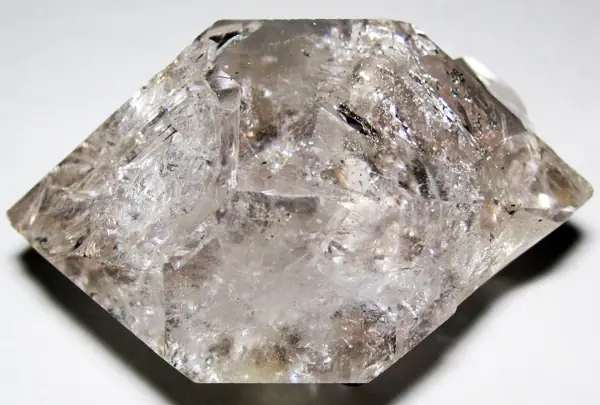
Photo: James St. John, CC BY 2.0 (credits). Illustrative.
Herkimer diamonds are not diamonds. They are exceptionally clear, naturally faceted quartz crystals with points at both ends, found in the dolostone bedrock of Herkimer County in central New York. The New York State Museum identifies them as quartz, named for their clarity and sparkle. You can dig for them yourself at fee-based surface mines such as Herkimer Diamond Mines, where you break open rock with a hammer and keep what you find. This guide covers the geology, how a visit works, what to bring, and how to tell a real Herkimer from glass.
What is a Herkimer diamond?
A Herkimer diamond is a double-terminated quartz crystal: it has a six-sided body with a pointed termination at each end, giving 18 natural faces. Most quartz crystals grow attached to rock at one end, so they have only one point. Herkimer crystals grew freely in open cavities, which allowed both ends to form.
Like all quartz, Herkimer diamonds are silicon dioxide with a hardness of 7 on the Mohs scale. Real diamond is carbon with a hardness of 10, so the name is a nickname, not a mineral identity. Some crystals contain inclusions, such as dark specks or tiny trapped fluid bubbles, which many collectors value. The New York State Museum notes that Herkimer diamonds are named after General Herkimer and are called diamonds for their clarity and bright sparkle.
The geology
Herkimer diamonds occur in the Little Falls Dolostone, a Late Cambrian rock unit described in a 1992 New York State Geological Association field guide by Herman Muskatt and Victor Tollerton of Utica College. Dolostone is a carbonate rock similar to limestone. It contains vugs, small cavities, in which the quartz crystals later grew. Herkimer Diamond Mine's own site describes its crystals as about 500 million years old, which matches the Cambrian age of the host rock.
Because the crystals are trapped inside hard dolostone, finding them usually means splitting rock. Crystals also weather out and can be found in loose rubble and soil at the base of exposures.
Digging at Herkimer Diamond Mines
Herkimer Diamond Mines in Herkimer, New York, runs above-ground surface mines. As of our November 2026 check, its official mine page said:
- The 2026 season runs April 12 to October 31, with mining registration 9 a.m. to 5 p.m., seven days a week. No reservations are needed.
- Admission includes an all-day prospecting ticket, collection bags and use of a rock hammer; an ID is held until hammers are returned. Instruction is given before you enter.
- Admission was listed at $19.00 for ages 13 and up and $16.00 for ages 5 to 12, with a surcharge on Fridays to Sundays; age 4 and under free. Children 4 and under are not given tools.
- Closed-toe shoes are required and eye protection is highly recommended.
- Tools over 12 pounds and powered equipment are not allowed.
- Mines close in unsafe weather such as snow, sleet, harsh rain and thunderstorms.
- Everything you find is yours to keep.
The mine also sells sluicing bags; it states that the only sluice bag containing Herkimer diamonds is its Herkimer Diamond Dirt Bag. Prices change, so confirm on the official site before your visit.
How to find Herkimer diamonds
There are two basic approaches:
- Surface searching. Look through loose rock and soil, especially after rain, for small, sparkling crystals. This is the easiest method for children.
- Splitting rock. Look for dolostone with visible cavities or a rusty, sparkly appearance. Strike it carefully with a rock hammer to open pockets. Pockets may hold one crystal or many, sometimes coated with clay or black hydrocarbon.
Tips:
- Wear safety glasses. Dolostone chips fly when struck. See safety gear.
- Use the right hammer. A geologist's hammer or a small sledge with a chisel works well. See rock hammers and picks and chisels and pry bars.
- Work slowly near a pocket. Crystals can break if you strike too close.
- Bring containers. Small crystals can be lost easily; padded boxes or egg cartons protect them.
What to bring
- Safety glasses and work gloves
- Closed-toe shoes or boots (required)
- Hammer and chisel if you prefer your own (within the mine's size limit)
- Buckets, a small trowel and a spray bottle of water to reveal sparkle
- Sun protection, water and snacks
See our full gem mining trip checklist.
Real Herkimer or glass?
Herkimer diamonds are often imitated. Signs of a genuine crystal:
- Natural double termination with smooth, flat, mirror-like faces; it is not a polished or cut shape.
- Hardness. Quartz scratches glass; glass cannot scratch quartz.
- Inclusions typical of the locality, such as dark specks or fluid bubbles. Glass imitations often contain round gas bubbles throughout.
Buying from the mine shop or finding your own is the most reliable way to know what you have.
Cleaning your crystals
Rinse crystals in warm water with a soft brush to remove clay. Black hydrocarbon coatings can be stubborn; soak and gently brush rather than scraping, which can scratch faces. Do not heat crystals, as rapid temperature changes can crack quartz.
Other New York collecting
The New York State Museum notes that garnet is New York's official gemstone, that the Barton Mine in the Adirondacks is the largest garnet mine in the world, and that the museum holds Herkimer diamonds from Herkimer County in its collection in Albany, a good stop for seeing top-quality specimens before you dig.
New York has other public collecting opportunities. Penn Dixie Fossil Park & Nature Reserve in Hamburg describes itself as a 54-acre former cement quarry where visitors can collect and keep Devonian fossils such as trilobites, brachiopods and crinoids. See our fossil hunting guide.
Browse all New York listings, the pay-to-dig list and our beginner's guide.
Visiting with kids
Herkimer digging is one of the most family-friendly gem activities in the Northeast because the mines are above ground and crystals can be found on the surface. The mine notes children 4 and under are not given tools, so plan for little ones to search loose rubble or try a sluice bag instead. See our guide to gem mining with kids.
FAQ
Are Herkimer diamonds real diamonds?
No. They are double-terminated quartz crystals from Herkimer County, New York. The New York State Museum identifies them as quartz.
Where can I dig for Herkimer diamonds?
Fee-based surface mines in Herkimer County, such as Herkimer Diamond Mines, let visitors split rock and keep what they find. Check the official site for the current season and prices.
How old are Herkimer diamonds?
The host rock, the Little Falls Dolostone, is Late Cambrian, about 500 million years old; the crystals grew later in cavities in that rock.
What tools do I need to mine Herkimer diamonds?
A rock hammer, safety glasses, gloves and closed-toe shoes. Herkimer Diamond Mines includes a hammer with admission and bans tools over 12 pounds and powered equipment.
Sources
- Mine – Herkimer Diamond Mines (official site)
- The Little Falls Dolostone (Late Cambrian): Stratigraphy and Mineralogy – NYSGA 1992 field guide
- Minerals of New York – New York State Museum
- Penn Dixie Fossil Park & Nature Reserve – official site
Sources checked 2026-11-04. Rules, hours and fees change; confirm with the operator or land manager before you go.