North Carolina Gem Mines: Where to Dig and What You Can Find
Updated 2026-11-04 · 1061 words
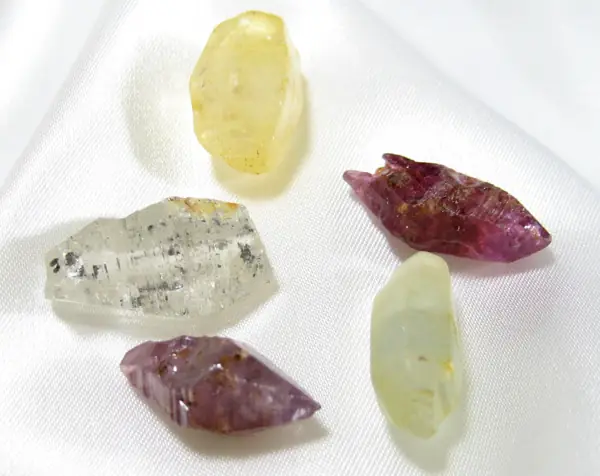
Photo: Ra'ike (see also Ra'ike on de.wikipedia, CC BY-SA 3.0 (credits). Illustrative.
North Carolina is one of the best states for gem mining because its geology produces real, native gems: rubies and sapphires in Macon County around Franklin, emeralds and the rare green gem hiddenite in Alexander County, emeralds in Mitchell County, and gold across the central Piedmont. The North Carolina Geological Survey says the state is the only one with significant emerald deposits. This guide covers the main regions, what you can find, and the mines in our directory, using facts from the state survey, state historic sites and the mines' own websites.
North Carolina's official state gems and minerals
According to the North Carolina Geological Survey:
- State mineral: gold, designated in 2011. The first major gold discovery in the U.S. happened in Cabarrus County in 1799, and North Carolina was the first gold-producing state.
- State precious stone: emerald. The survey's emerald fact sheet says the General Assembly designated emerald as the state's official gemstone in 1973, and that the first documented discovery of emeralds in North Carolina was in Alexander County in 1874.
- State rock: granite.
- State fossil: megalodon teeth, designated in 2013.
The survey also notes the state is known as a producer of hiddenite, a rare green gemstone from Alexander County, and of rubies and sapphires found in Macon County.
Franklin and Macon County: rubies, sapphires and garnets
The Franklin area in Macon County is North Carolina's best-known ruby and sapphire region. Rubies and sapphires are both corundum: red corundum is ruby, other colors are sapphire. Rough stones are often opaque and pink, red, gray or bluish, and they are noticeably heavy for their size.
Mines in our directory near Franklin include:
- Cherokee Ruby & Sapphire Mine, which lists native rubies, sapphires and garnets and states that it does not salt or enrich its gravel. Its website says it is open year-round, 10 a.m. to 4 p.m., opening at 9 a.m. in summer (checked November 2026; confirm before you go).
- Elijah Mountain Gem Mine, mapped in OpenStreetMap as a gem mine; call to confirm details.
- The Rocks Gemstone Mining, also mapped in OpenStreetMap; call to confirm.
Most Franklin-area mines use buckets and a flume. Read salted vs. native buckets before you buy, and see how to identify common finds for what rough corundum looks like.
Hiddenite and Alexander County: emeralds and hiddenite
Alexander County, in the foothills west of Statesville, is where North Carolina's first emeralds were documented, according to the state survey. Emerald is a green variety of beryl, colored by trace chromium or vanadium, with a hardness of 7.5 to 8. Hiddenite is a rare green gemstone associated with the same area.
Emerald Hollow Mine in Hiddenite describes prospecting for emeralds and other gemstones by sluicing, creeking and digging, and states that it is the only emerald mine in the world open to the public for prospecting. We list its details from the official website; hours and fees are not shown on our page because we could not confirm them there.
Spruce Pine and Mitchell County: pegmatite minerals
The Spruce Pine area in Mitchell County sits on mineral-rich pegmatites, coarse-grained granite rocks that can contain large crystals of feldspar, mica, quartz, beryl and garnet. The state survey names Mitchell County as one of the two counties with significant emerald deposits. Gem Mountain Gemstone Mine is in our directory for this area; call to confirm hours and fees.
Gold: Reed Gold Mine and the Piedmont
Reed Gold Mine State Historic Site in Midland, Cabarrus County, is the site of the first documented gold find in the United States, according to NC Historic Sites. The site says gold mining spread from there to nearby counties and other southern states, that at its peak it was second only to farming in the number of North Carolinians it employed, and that North Carolina led the nation in gold production until 1848, when it was eclipsed by the California Gold Rush.
As of our November 2026 check, the site's official page lists:
- Hours: Tuesday to Saturday, 9 a.m. to 5 p.m.; closed Sunday, Monday and designated state holidays.
- Admission: free; fees are charged for guided mine tours and gold panning (panning listed at $5.00 per person plus tax).
- Panning closes during moderate to heavy rain, for 30 minutes after thunder, and when the heat index is above 103 degrees.
Our directory also lists Vein Mountain Gold Camp / Carolina Emerald Mine in the western Piedmont. See how to pan for gold to prepare.
Collecting on public land in North Carolina
Western North Carolina is full of national forest land, but the rules are strict. The National Forests in North Carolina say:
- Rockhounding is limited to surface collection; digging is not permitted.
- A reasonable amount is generally up to 10 pounds of surface specimens; more requires a permit.
- Gold panning is allowed only in the stream bed, with a standard gold pan and a small hand tool, and holes must be backfilled.
- Shovels, picks, sluice boxes and suction dredges are prohibited.
- Commercial collecting requires authorization.
Because of these limits, pay-to-dig mines are the practical choice for most visitors who want to dig. The state survey's Information Circular 24 lists historic mineral collecting localities, but many are on private land and need permission.
Planning a North Carolina gem trip
- Pick a region. Franklin for rubies and sapphires; Hiddenite for emeralds; Spruce Pine for pegmatite minerals; the Charlotte area for gold.
- Check the season. Many mountain mines are seasonal; some are year-round. Check each mine's website.
- Ask about native gravel if you want local stones.
- Bring clothes that can get wet, sun protection, a container for finds and a loupe. See our gem mining trip checklist.
- Plan for cutting. Many mines offer cutting and setting. See getting finds cut or faceted.
Browse all North Carolina listings or the national pay-to-dig gem mines list.
A short history
Mining in North Carolina goes back more than two centuries. The Reed find in 1799 started the country's first gold rush. Gems followed later in the nineteenth century, including the documented emerald discovery in Alexander County in 1874. Today, most mining in the mountains is recreational, and the state's gem mines are a major draw for families visiting the Blue Ridge.
FAQ
Where can you find rubies in North Carolina?
The North Carolina Geological Survey notes rubies and sapphires in Macon County, around Franklin. Several pay-to-dig mines there sell gravel to wash.
Can you find emeralds in North Carolina?
Yes. The state survey says North Carolina is the only state with significant emerald deposits, in Alexander and Mitchell counties. Emerald Hollow Mine in Hiddenite lets the public prospect.
Can I dig for gems in North Carolina national forests?
Only surface collecting of up to about 10 pounds is generally allowed, with no digging, per the National Forests in North Carolina. Panning is limited to the stream bed with a standard pan.
Where was gold first found in the US?
At what is now Reed Gold Mine in Cabarrus County, North Carolina, in 1799, according to NC Historic Sites and the North Carolina Geological Survey.
Sources
- NC Geology FAQ – North Carolina Geological Survey
- Emeralds – North Carolina Geological Survey
- Information Circular 24: Mineral Collecting Sites in North Carolina – NCGS
- Reed Gold Mine – NC Historic Sites
- Recreational Mineral Collection – National Forests in North Carolina
- Cherokee Ruby & Sapphire Mine – official site
- Emerald Hollow Mine – official site
Sources checked 2026-11-04. Rules, hours and fees change; confirm with the operator or land manager before you go.