Sluice Box vs. Gold Pan: Which One Do You Need?
Updated 2026-11-04 · 1020 words
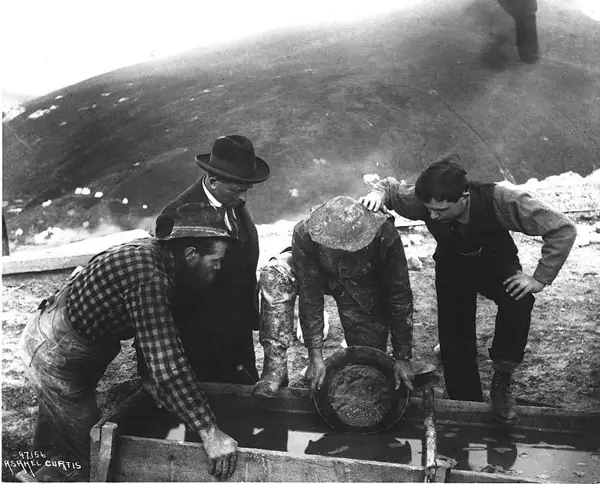
Photo: Asahel Curtis, Public domain (credits). Illustrative.
A gold pan is the cheapest, most portable way to find gold and is allowed almost everywhere recreational panning is permitted. A sluice box processes far more gravel in the same time, but many public areas restrict or ban sluices. Most beginners should start with a pan, learn to read gravel, then add a small sluice where the land manager allows it. The rules matter: the National Forests in North Carolina prohibit sluice boxes outright, while Alaska's Caribou Creek allows small sluices only in a seasonal window. This guide compares the two tools and shows how to use them together.
How a gold pan works
A pan works because gold is very heavy. USGS gives the specific gravity of gold as 19.3, compared with about 2.5 for common gangue minerals, so when you shake a pan underwater, gold sinks to the bottom while lighter material is washed over the edge. A pan is also the tool you use to finish the concentrates from a sluice.
Advantages:
- Cheap, light and simple.
- Allowed in nearly every place that permits recreational panning.
- Lets you sample many spots quickly to find where gold is.
Limits:
- Slow: you can only process a small amount of gravel per hour.
- Technique takes practice.
See our step-by-step guide to how to pan for gold and our gold pan and classifier picks.
How a sluice box works
A sluice is a long, open trough that uses flowing water. You set it in the current, shovel gravel into the top, and water carries the material down over riffles and a mat. Heavy particles, including gold and black sand, drop behind the riffles and into the matting, while lighter material washes out the end. Periodically you stop, remove the mat and riffles, wash the concentrates into a bucket, and pan them out.
Advantages:
- Processes much more gravel than a pan, so it can recover more gold from a good spot.
- Less tiring per bucket than hand panning.
Limits:
- Needs the right water flow and a careful setup.
- Heavier and more to carry.
- Restricted or banned in many public areas.
- Still requires a pan to finish concentrates.
See our sluice box picks.
Where sluices are allowed
This is the most important difference. Examples from official sources:
- National Forests in North Carolina: panning is allowed only in the stream bed with a standard gold pan and a small hand tool; shovels, picks, sluice boxes and suction dredges are prohibited.
- Black Hills National Forest (South Dakota): hand panning needs no permit, but motorized equipment and dredges require a Notice of Intent.
- Caribou Creek Recreational Mining Area (Alaska): gold pans and hand shovels are allowed year-round, while a small hand-fed sluice box is allowed only during a seasonal window set to protect fish migration, and sluices must be set back so muddy water does not flow into the creek.
- BLM land: BLM treats hand tools such as pans and shovels as generally fine for casual use with minor disturbance; check with the local field office about sluices and anything motorized.
- National parks: NPS rules under 36 CFR 2.1 prohibit removing minerals, so neither tool is appropriate unless the park allows it.
Many pay-to-pan attractions and gem mines provide a flume, which works like a sluice, for washing buckets. See the gold panning list.
Using a pan and a sluice together
The classic workflow:
- Sample with a pan. Pan a few scoops from different spots: on bedrock, in cracks, behind boulders and on the inside of bends.
- Find color. When a spot consistently shows gold in the pan, it is worth processing more gravel.
- Run the sluice there, where allowed.
- Clean up. Wash the mat and riffles into a bucket.
- Pan the concentrates to separate gold from black sand.
Setting up a sluice
- Find steady current that runs smoothly through the box without rushing.
- Set the slope so water flows evenly and the riffles show light movement of gravel.
- Classify first. Screening gravel through a classifier removes rocks that can disturb the riffles.
- Feed slowly. Overloading washes gold out the end.
- Mind the stream. Keep the area tidy, fill holes, and follow any rules about turbidity and setbacks.
Side-by-side comparison
- Gravel processed: a pan handles a small amount at a time; a sluice handles many times more in the same period.
- Portability: a pan nests inside a bucket; a sluice is longer and heavier, though small aluminum and plastic models pack reasonably well.
- Skill: panning takes practice to avoid losing gold; a sluice takes practice to set up correctly.
- Where allowed: pans almost everywhere panning is permitted; sluices only where the land manager allows them.
- Fine gold: both can lose very fine gold if used poorly. Slow feeding, classified material and careful cleanup help.
Common sluice mistakes
- Too much water speed, which scours the riffles and carries gold out.
- Too little flow, which lets riffles pack with sand so they stop catching anything.
- Skipping classification, so large rocks disrupt the flow.
- Cleaning up too rarely, so the mat overloads with black sand.
- Setting up in the wrong spot. USGS notes that placer gold concentrates in pay streaks, often on or near bedrock. A sluice cannot make poor gravel rich, so sample with a pan first.
Which should you buy first?
For most beginners, a pan and a classifier screen come first: they are inexpensive, legal in more places, and teach you how gold behaves. Add a small sluice when you have found a productive spot where sluicing is allowed. Our beginner's guide to gem mining and trip checklist cover the rest of a starter kit.
Other tools
- Rocker box and high banker: larger devices that bring water to gravel away from the stream; often regulated.
- Suction dredge: motorized and heavily regulated; prohibited in many places.
- Metal detector: good for nuggets in dry ground; see our metal detector guide.
FAQ
Is a sluice box better than a gold pan?
A sluice processes more gravel, but a pan is cheaper, more portable and allowed in more places. Most prospectors use both: a pan to sample and finish, a sluice to process volume where allowed.
Are sluice boxes allowed in national forests?
It depends on the forest. The National Forests in North Carolina prohibit sluice boxes, while other forests allow them with limits. Check with the local ranger district.
Do I need a permit for a sluice box?
Sometimes. Some areas allow non-motorized sluices without a permit, others restrict them by season or ban them. Motorized equipment usually needs a notice or permit.
How does a sluice catch gold?
Water carries gravel over riffles and matting, and heavy particles like gold settle out while lighter material washes away.
Sources
- Prospecting for Gold in the United States – USGS
- Recreational Mineral Collection – National Forests in North Carolina
- Gold Panning, Rockhounding & Metal Detecting – Black Hills National Forest
- Caribou Creek Recreational Mining Area fact sheet – Alaska DNR
- Can I Keep This? – Bureau of Land Management
- 36 CFR 2.1 – Cornell LII
Sources checked 2026-11-04. Rules, hours and fees change; confirm with the operator or land manager before you go.